
Professor Bove explains why PROMs, Patient-Reported Outcome Measures, complement clinical data and help patients and surgeons make more informed decisions.
Professor Pierluigi Bove, urologist, head of the U.O.S.D. of Robotic and Minimally Invasive Urology at Policlinico Tor Vergata and Associate Professor of Urology at the University of Rome Tor Vergata, emphasizes that when we talk about surgery, patients are often informed about percentages, techniques, operating times, chances of success, risks and possible complications.
These are important data, because they help patients understand the value of a treatment and make decisions with greater clarity. However, they do not always fully describe what the patient will experience after surgery, during recovery, in daily functions and in overall quality of life.
Why the success of an operation does not always coincide with the success of care
Every day, I enter the operating room to treat a prostate, a bladder or a tumor.
But before being an organ to be treated, the person in front of me is a human being.
This may seem obvious. In reality, it is perhaps one of the most difficult things to remember in everyday clinical practice.
As surgeons, we are used to talking about surgical margins, operating times, blood loss, complications, urinary continence, erectile function and oncological survival.
These are essential data. They are what guide evidence-based medicine.
The patient, however, almost never asks me these questions.
A man who is about to undergo surgery for benign prostatic hyperplasia rarely asks me which technique I will use.
Instead, he asks me:
“Doctor, will I still have normal ejaculation after the operation?”
For many people, this may seem like a detail.
For him, it represents part of his identity, his intimacy and his relationship with his partner.
In prostate cancer, something very specific often happens.
Before surgery, the patient is understandably focused on one thing only: being cured. The fear of the disease is so strong that everything else moves into the background. When we talk about possible side effects, such as urinary incontinence or erectile dysfunction, he listens, understands them rationally, but often cannot yet imagine what they will really mean in his life.
At that stage, the question is only one:
“Doctor, will I be cured?”
Then a few weeks pass. The first follow-up visits arrive. PSA is undetectable. From an oncological point of view, the operation has been successful. The fear of the disease slowly begins to make room for a new awareness.
That is when many patients truly begin to face the consequences of surgery.
Urinary incontinence, even when it is expected to improve, can limit social and professional life. Erectile dysfunction is not only a functional loss: it can challenge masculine identity, intimacy within the couple, self-esteem and the very way a man perceives himself.
The question then changes profoundly.
It is no longer:
“Will I be cured?”
It becomes:
“Will I be able to become the person I was before?”
And it is precisely at this point that we understand how oncological success, although fundamental, does not exhaust the meaning of care.
For the patient, healing does not coincide only with an undetectable PSA.
It coincides with the possibility of returning to life, to love, to work and to feeling like himself again.
Beyond the Technical Result
Over the last thirty years, surgery has made extraordinary progress.
Robotics, advanced endoscopy, lasers, intraoperative imaging and precision medicine have radically improved the safety of surgical procedures. Today, we can accurately measure oncological radicality, blood loss, duration of surgery, length of hospital stay, complications and functional recovery.
These are indispensable parameters. But they mainly describe what happens in the operating room.
They say much less about what happens when the patient returns home. A technically perfect operation can still leave the patient unprepared to face changes that deeply affect his life.
For this reason, the international scientific community is gradually changing perspective.
The question is no longer only:
“Was the operation successful?”
The question is becoming:
“Has the patient returned to the life he wanted to live?”
This is the principle of patient-centered care and Value-Based Healthcare: the value of care is not measured only through clinical outcomes, but also through the outcomes that truly matter to the person receiving that care.
The rise of PROMs
This cultural evolution has led to growing interest in PROMs (Patient Reported Outcome Measures). These are validated questionnaires that collect the patient’s voice directly, before and after a treatment.
They do not ask the doctor whether the operation went well. They ask the patient.
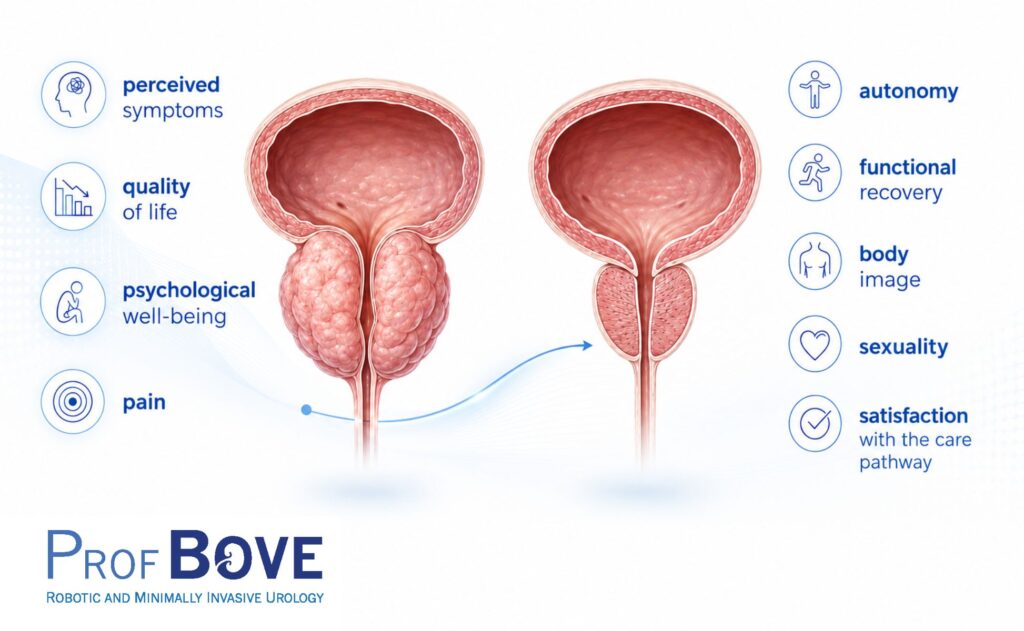
PROMs measure aspects that no CT scan, MRI or blood test can describe:
- quality of life;
- perceived symptoms;
- functional recovery;
- autonomy;
- pain;
- sexuality;
- body image;
- psychological well-being;
- satisfaction with the care pathway.
PROMs do not replace clinical data. They complete them. Because the patient does not live a percentage. He lives his own story.
When the patient describes something we cannot see
Examples in urology are now numerous.
Radical prostatectomy
Today, the EPIC-26 (Expanded Prostate Cancer Index Composite) is one of the most widely used PROMs in the world.
It does not measure only urinary continence and erectile function, but how these changes truly affect the patient’s quality of life. Two men with the same surgical result can experience completely different realities. One may feel satisfied. The other may perceive a significant loss of his sexual identity.
From a clinical point of view, these may be two identical operations. From a human point of view, they are two completely different stories.
Benign prostatic hyperplasia
In surgery for benign prostatic hyperplasia, we are also beginning to understand that success does not coincide only with improved urinary flow or a reduction in IPSS score.
A patient may urinate perfectly after HoLEP or ThuLEP. But he may experience discomfort due to the loss of antegrade ejaculation.
For some men, this is an easily acceptable side effect. For others, it profoundly changes the perception of their sexuality. These are aspects that no uroflowmeter can measure.
Radical cystectomy
This is probably the clearest example. Quality of life after urinary diversion certainly depends on the surgical technique. But it also depends on psychological adaptation, body image, life as a couple, returning to work and the ability to regain autonomy.
Two patients with the same neobladder can describe completely different journeys. And this is exactly what PROMs finally allow us to understand.
A cultural revolution
For many years, we mainly measured what was important to the surgeon. Today, we are beginning to measure what is important to the patient.
This is an enormous difference. Because it means recognizing that quality does not coincide only with the absence of complications. It means understanding whether the patient felt listened to. Whether he truly understood what to expect. Whether recovery was properly supported. Whether he was able to return to his life.
This is not merely a methodological issue. It is a cultural change.
Quality Continues After the Operating Room
Care does not end when the surgical wound is closed. It begins much earlier, with truly shared informed consent.
It continues during hospitalization. And it goes on in the following months, when doubts, difficulties, fears and new needs emerge. This is why I consider PROMs a valuable tool. Not because they replace the surgeon’s experience.
But because they help the surgeon see what is often difficult to observe.
Systematically listening to the voice of patients means improving communication, refining follow-up, correcting unrealistic expectations and, above all, building care that is increasingly closer to people.
The future of surgery
I am convinced that the surgery of the future will not be defined only by more advanced robots, new technologies or artificial intelligence.
It will be defined by our ability to integrate technical innovation with an increasingly deep understanding of the human experience of illness.
Because we can measure PSA. We can measure a surgical margin. We can measure survival. But the value of care can only be truly understood when we ask the patient: “How are you experiencing your new life?”
And perhaps this is the most important evolution of modern surgery: not only learning to operate better, but learning to listen better.
References
PROMs, Patient-Reported Outcome Measures, surgical quality, patient experience, quality of life after surgery, preoperative information, preoperative expectations, functional recovery, patient satisfaction, patient-reported outcomes, informed consent, doctor-patient communication, shared decision-making, urology, urologic surgery, Professor Pierluigi Bove.

