
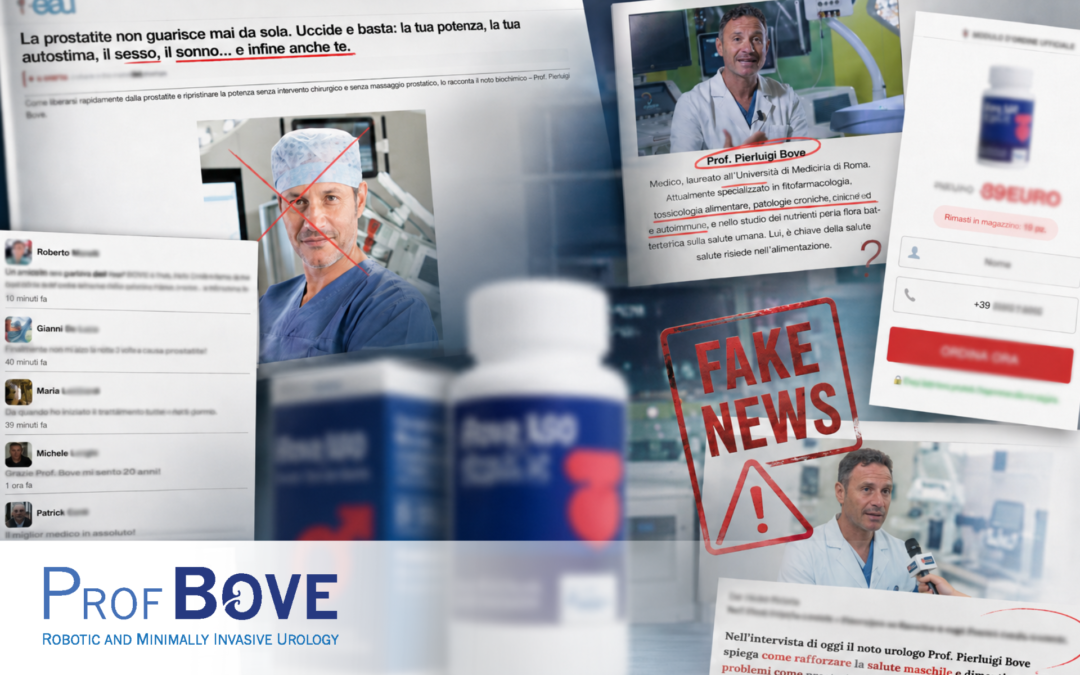
Professor Bove explains why he chose to write this article and launch a social media series aimed at helping patients find their way through medical information and misleading content:
“Over the past few years, I have seen various inaccurate online contents circulating that involved my image. Some patients felt confused and asked me for clarification about products they believed I was selling. This article and this series were born from that experience: to help people distinguish between scientific information, aggressive marketing, and scams.
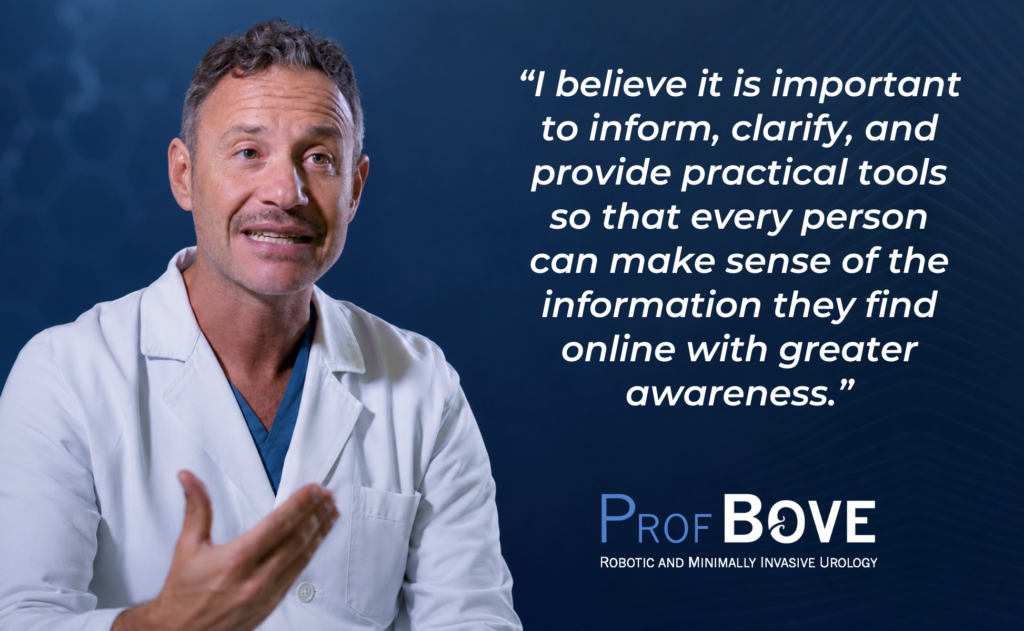
There is also a more personal reason. It is deeply unpleasant to discover that one’s identity, one’s name, and the trust built over years of work are being used without authorization to deceive people. In a sense, it represents the exact opposite of the medical profession, which is based on transparency, ethics, and the protection of the patient. That is why I believe it is important to inform, clarify, and provide practical tools so that each person can make sense of the information they find online in an aware and thoughtful way.”
A practical guide to finding your way through viral content, aggressive marketing, and messages that may interfere with treatment decisions.
Today, it is easier than ever to come across medical content online that promises quick results, definitive solutions, and “simple” answers to complex problems. The issue is not online searching in itself, but the fact that scientific information, commercial communication, and, at times, outright scams now coexist in the same space.
Many patients come to their appointment with legitimate questions: “I read that this treatment is definitive,” “I was told that no tests are needed,” “I saw a video explaining that…”. In these cases, the doctor’s role is to bring the discussion back onto solid ground: a correct diagnosis, proper indications, limits, and the real risks and benefits.
Professor Pierluigi Bove sums it up this way: “The point is not to demonize what people find online, but to give patients simple criteria to understand whether a piece of information is reliable and whether it applies to their case.”
Why claims that seem “too good to be true” are effective
“Misleading messages,” Prof. Bove continues, “often have one thing in common: they speak to emotion, not to clinical reasoning. They offer certainty where, in medicine, there are probabilities. They offer shortcuts where, in real life, careful assessment and a proper clinical pathway are needed. And above all, they almost always avoid the central point: before talking about treatment, you need a well-defined diagnosis and a clear understanding of whether a person is truly a candidate for that treatment.”
This is often seen in urology. People talk about the prostate, about techniques “without side effects,” guaranteed results, or certain preservation of delicate functions. The problem is not discussing modern options, but doing so without criteria, without limits, and without proper clinical framing.
Ten warning signs that, according to Prof. Bove, should raise concern
- Guaranteed promises
If a piece of content says “it always works” or “it works for everyone,” it is already moving outside serious medical practice. - No diagnosis, only a solution
When the proposal starts straight away with the treatment, without explaining how the diagnosis is reached, an important step is missing. - No indications or contraindications
Every procedure has criteria. If they are not mentioned, that is an important warning sign. - Only testimonials, no data
Testimonials may be genuine, but they do not replace clinical criteria. If they are the only “proof,” caution is needed. - Urgent and pressuring language
“Decide now,” “if you wait, it will get worse,” “last chance.” Serious medicine reflects; it does not pressure. - A “secret” or “exclusive” method without verifiable explanations
If it is not clear what is being done, how it is done, and within what limits, it cannot be properly assessed. - Attacks on medicine or doctors
Phrases such as “what doctors or big pharma do not want you to know” or “they will never tell you this” are meant to create distrust, not to inform. - Confusing general wellbeing with the treatment of a disease
Talking about lifestyle is very different from talking about the treatment of an illness. - Price and bonuses at the center, medical content in the background
If the commercial side dominates, the priority is not clinical. - No follow-up, no “afterwards”
A serious medical pathway also explains follow-up, possible effects, and what happens if the expected result does not arrive.
A simple rule: first understand, then choose
Reliable content, even if brief, should help patients make sense of the issue. At the very least, it should clarify:
- what problem is being treated
- how it is diagnosed
- who a certain option is indicated for, and who it is not indicated for
- what can realistically be expected
- what alternatives exist
When these elements are missing, there is no real clinical information, only communication designed to persuade.
A practical checklist in 7 questions
To find your way more clearly, Professor Pierluigi Bove proposes a practical seven-question checklist that helps distinguish clinical information from misleading claims.
- What is the exact diagnosis we are talking about?
- Is the person proposing the solution a specialist in that area?
- What tests are needed to determine whether I am a candidate?
- Are the limits and risks explained, or not?
- Are there alternatives, and are they presented correctly?
- Is there a follow-up plan and a plan for what comes after?
- If it does not work, what is the next step?
If a piece of content does not allow us to answer these questions, it is not a solid basis for making a decision.
What to do when a piece of content sounds convincing but something feels off
“The most useful choice is usually one,” Professor Bove concludes: “bring that content to your appointment and discuss it. Not to disprove the internet, but to understand whether that message makes sense in your own case. Sometimes the technology is real, but it is not indicated for everyone. Sometimes the promise is built around an ideal case that does not represent the majority. And sometimes, quite simply, there is no clinical basis behind it.”
Medicine is not protected by slogans, but by clarity. An informed patient is not a patient who “knows everything,” but a person who has the tools to ask the right questions and to distinguish between serious communication and messages that create unrealistic expectations. That is where mistakes, disappointment, and above all risks to the patient can be reduced.
References:
medical fake news, scams in medicine, misleading health advertising, aggressive medical marketing, medical communication, patient education, scientific information online, how to recognize miracle cures, unrealistic claims in medicine, diagnosis before treatment, informed choice in the care pathway, indications and contraindications, risks and benefits of treatments, quality of life and clinical decisions, doctor-patient relationship, urology and online information, Prof. Pierluigi Bove, urology Rome, urologic oncology, sound clinical judgment

